Abstract
Background: This study explores the labour system that existed among the Tagin tribe during the prehistoric era. Before the introduction of monetary wages, the Tagins relied on locally available sources of labour, such as family members, clan groups, neighbours, relatives, slaves, and reciprocal exchange of work (Rwkyi). During that era, workers were compensated through cultural and customary forms of payment, such as rice beer, meat, rice, millet, local ornaments, and sometimes livestock, such as chickens. Objectives: The study aims to understand the traditional labour system of the Tagin Tribe during the prehistoric era. It seeks to examine the sources of labour, its uses, the participation of women, forms of payment, and methods used to measure compensation. Additionally, this research intends to document the traditional labour practices of the Tagin tribe. Method: This study uses qualitative and ethnohistorical methods. Findings: The findings indicate that the Tagin labour system was deeply rooted in cooperation and reciprocity, where work was both a social duty and a cultural practice. This traditional system ensures the survival of the community in a challenging environment and plays an important role in maintaining social harmony and collective responsibility.
Keywords
Traditional Labour System, Labour Force, Tagin Tribe, Upper Subansiri, Cultural Payment Methods, Arunachal Pradesh
1. Introduction
The Tagin people, a prominent tribe of Arunachal Pradesh, possess a deep cultural heritage shaped by oral narratives, ancestral myths, and everyday survival practices. Their traditional homeland in Upper Subansiri, marked by steep mountains, thick forests, and wide river valleys, played a major role in forming the community’s early patterns of work and social life
| [1] | Neba, G. (2019). Customary Laws of the Tagin tribe of Arunachal Pradesh: Continuity and Change (1st ed.). Abhijeet Publication. |
[1]
. Although earlier writings on Tagin culture mostly focus on rituals, kinship bonds, and festivals, very little attention has been given to how the labour system was practised during the prehistoric era
.
Exploring prehistoric labour is important because it reveals how Tagins adjusted to their environment long before metal tools or organised institutions came into existence. This paper seeks to reconstruct these early forms of labour by drawing on ethnohistorical methods.
1.1. About Tagin Tribe
The Tagin community is one of the prominent tribes of Arunachal Pradesh and forms an integral part of the wider Tani group, who trace their ancestry to the legendary forefather Abu Tani. They are known for their warm hospitality and friendly nature
. Although they are primarily concentrated in the Upper Subansiri District, Tagins have also expanded their settlements into neighbouring regions. Among their rich cultural traditions, the most significant celebration is the
Si-Donyi Hilo festival, a sacred observance dedicated to honouring the earth (
Si) and the sun (
Donyi). Central to the celebration is the role of the
Nyibu (traditional priest), who leads the rituals and chants the sacred
Uuyu Benam (celestial chanting) to invoke blessings from the celestial forces. A key ritual during the festival is the sacrificial offering of the mithun (gayal), performed to seek peace, prosperity, and the overall well-being of the entire community
| [1] | Neba, G. (2019). Customary Laws of the Tagin tribe of Arunachal Pradesh: Continuity and Change (1st ed.). Abhijeet Publication. |
| [4] | Badi, T. (2025). Tagin Tribe’s Sacred Biodiversity Practices. Frontier Anthropology, 14, 5-12.
https://www.frontieranthro.in/fa-2025a2 |
| [5] | Goswami, P., Soki, D., Jaishi, A., Das, M., & Sarma, H. N. (2009). Traditional healthcare practices among the Tagin tribe of Arunachal Pradesh. Indian Journal of Traditional Knowledge, 8(1), 127-130.
https://www.researchgate.net/publication/228763366_Traditional_healthcare_practices_among_the_Tagin_tribe_of_Arunachal_Pradesh |
| [6] | Kodak, T. (2022). Customary Law and Gender Inequality of Tribal Society with Special Reference to Tagins of Arunachal Pradesh | EPRA International Journal of Multidisciplinary Research (IJMR). EPRA International Journal of Multidisciplinary Research, 8(3), 1-4.
https://eprajournals.com/IJMR/article/6659/abstract |
| [7] | Sarkar, Niranjan. (1999). The Tagins. Dept. of Cultural Affairs, Directorate of Research, Govt. of Arunachal Pradesh. |
[1, 4-7].
According to the 2011 Census, the Tagin population in India stands at approximately 62,931, reflecting their strong and vibrant presence within the cultural landscape of Arunachal Pradesh
| [8] | Directorate of Census Operations, A. P. (2011a). India - Census of India 2011 - Arunachal Pradesh - Series 13 - Part XII A - District Census Handbook, Upper Subansiri. Office of the Registrar General & Census Commissioner, India.
https://censusindia.gov.in/nada/index.php/catalog/188 |
[8]
.
1.2. About Tagin Tribe
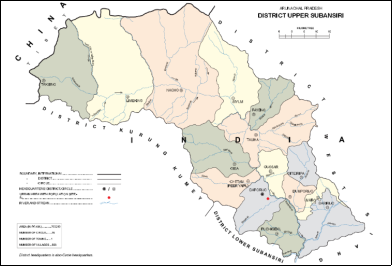
Upper Subansiri is a vast and scenic district in the northeastern Indian state of Arunachal Pradesh, with its administrative headquarters in Daporijo. The district was created in the year 1980 in the name of Upper Subansiri. Covering an area of approximately 7,032 sq km, the district is sparsely populated, reflecting its rugged terrain and remote location
.
Figure 1. Upper Subansiri District (Directorate of Census Operations, 2011).
According to the 2011 Census, Upper Subansiri District has a total population of 83,448, consisting mainly of tribal communities such as Tagin, Nyishi, and Galo. Among them, the Tagin tribe forms the dominant group, accounting for approximately 70% of the district’s total population
| [11] | Directorate of Census Operations, A. P. (2011b). India - Census of India 2011 - Arunachal Pradesh - Series 13 - Part XII B - District Census Handbook, Upper Subansiri. Office of the Registrar General & Census Commissioner, India.
https://censusindia.gov.in/nada/index.php/catalog/189 |
[11]
.
1.3. Significance of the Study
This study is significant as it documents and analyses the traditional labour system of the Tagin tribe during the prehistoric era, a topic that has received limited attention in scholarly literature. By relying on oral narratives and Indigenous knowledge, this research preserves valuable cultural information that is rapidly disappearing due to social and economic changes. It provides a deeper understanding of how labour, cooperation, and exchange were organised in a non-monetary society, enriching the broader discourse on tribal economies and early labour systems in the region. The study also highlights community-based labour arrangements, such as reciprocal work exchange and culturally embedded forms of compensation, shedding light on the social values of cooperation, mutual support, and collective responsibility that sustained Tagin society.
Furthermore, this research includes women’s participation in agricultural and household labour, addressing gender dimensions often overlooked in studies of tribal labour systems. This adds to the comprehensiveness of the study by showing how both men and women contribute to the functioning of traditional labour practices. Overall, this study serves as a valuable reference for researchers, historians, anthropologists, and policymakers interested in Indigenous labour practices and cultural heritage, while also providing a foundation for future comparative studies on tribal labour systems in Arunachal Pradesh and the wider North-East Indian region.
2. Literature Review
To build a clearer understanding, key previous studies on local labour systems in Arunachal Pradesh are presented below.
In their paper titled “
Labour Force in Arunachal Pradesh During Pre Historic Period: A Historical Perspective” (2020), explain that the labour in the early tribal societies of Arunachal Pradesh primarily came from within the community itself through family members, kinship networks, villagers, neighbouring settlements, and slaves. They further note that understanding these early labour systems is challenging because much of this history was never documented. As a result, oral traditions remain the only way to reconstruct the deeper past and gain insights into how labour was organised in those times
In their paper
“Labour under British Colonial Period in Arunachal Pradesh – A Retrospection” (2020), examine how labour systems in Arunachal Pradesh were reshaped with the establishment of British colonial rule. They pointed out that the expansion of colonial economic activities, including tea and rubber plantations, cane and bamboo extraction, and sawmill industries, led to an increased reliance on wage labour. These developments gradually undermined the indigenous subsistence-based and community-oriented labour practices that had long prevailed in the region. Camder also notes that the reluctance of local tribal communities to participate in colonial labour arrangements forced the British to bring in labourers from outside the region. This transition to monetised labour relations represented a clear departure from traditional systems and initiated lasting structural changes in labour organisation. This study is relevant to the present research as it offers a historical context for understanding earlier labour systems, particularly by drawing attention to the contrast between Indigenous community-based labour practices and the transformations introduced during the colonial period
In his classic ethnographic work
“The Apa Tanis and Their Neighbours” (1962), describes an interesting cooperative labour tradition practiced by the Apatani tribe known as Patang. According to him, every Apatani child, whether a boy or a girl, becomes part of this labour-sharing group from an early age. As they grow, they learn to support each other in various agricultural activities, creating a strong sense of collective responsibility. Whenever a household requires extra hands during field preparation, sowing, or harvesting, the Patang group members readily come together to help. In return, the assisted family is expected to offer the same support when others need it. This system of mutual labour exchange not only ensured that no family faced agricultural challenges alone but also strengthened social bonds and maintained harmony within the community. Haimendorf’s observations show how deeply rooted cooperation and reciprocity were in traditional tribal societies, reflecting a labour culture built on trust, friendship, and shared survival
| [13] | Von Fürer-Haimendorf, C. (1962). The Apa Tanis and their neighbours: A primitive civilization of the Eastern Himalayas. In The Apa Tanis and their Neighbours: A Primitive Civilization of the Eastern Himalayas (1st Edition). Taylor and Francis. https://doi.org/10.4324/9781315017822 |
[13]
.
In his paper
“Arunachal’s Tribal Economic Formation and Their Dissolution” (1984), offers valuable insights into how labour was traditionally organised among the tribal communities of Arunachal Pradesh. His study points out that in the absence of formal labour markets, the earliest sources of manpower were drawn directly from within the community itself. Family members formed the core workforce, supported by fellow villagers and people from nearby settlements whenever required. Mishra explains that these labour arrangements were guided by the principles of reciprocity, mutual obligation, and shared community interests. People helped one another not for wages but because collective survival depended on cooperation. This system of exchanging labour created strong social bonds and ensured that essential tasks, such as farming, house building, and gathering forest resources, were carried out smoothly through communal effort
.
In his work
“Economic Under Development of Arunachal Pradesh: A Historical Perspective” (1997), offers a detailed analysis of how labour was structured in the early tribal economy of Arunachal Pradesh. He explains that the primitive labour system was organised around six key productive activities: hunting, fishing, gathering forest resources, animal husbandry, crop cultivation, and various forms of handicraft-making, which together formed the core of daily survival and reflected the tribes’ deep dependence on their natural surroundings. Sikdar further observes that labour relations during this period functioned on two levels: a strong kinship-based system, where families and clans worked collectively and shared responsibilities, and a master–slave system, where individuals captured during conflicts or those unable to pay compensation became bonded labourers. Although these patterns differed across tribes, his study highlights that both cooperative kinship networks and hierarchical labour arrangements played crucial roles in shaping the economic life of early Arunachal Pradesh
| [15] | Sikdar, S. (1997). Economic Underdevelopment of Arunachal Pradesh: A Historical Perspective. Himalayan Publishers. |
[15]
.
3. Research Gap
Although previous research outlines the general labour traditions of Arunachal Pradesh tribes, no study documents prehistoric labour practices when the monetary system was not introduced in the Tagin Tribe. The absence of written records further limits our understanding, making it necessary to investigate how labour was structured and shared among the Tagins in the early period.
4. Objectives
This study aims to closely examine the traditional labour system of the Tagin tribe, with the following objectives designed to provide a clear focus and direction for the research.
1) To understand the traditional labour system of the Tagin tribe in the prehistoric era.
2) To examine the sources of labour, uses of labour, participation of women in labour, forms of payment, and measurement of payment scales of the Tagin Tribe during the prehistoric era.
3) To document the traditional labour system of the Tagin tribe during the prehistoric era.
5. Research Methodology
This study adopts an ethnohistorical and qualitative research approach to explore the labour system in the prehistoric era of the Tagin tribe. Since written records about early Tagin society are limited, this research relies primarily on oral data collected from individuals who possess traditional knowledge and cultural expertise.
5.1. Research Design
This study followed a qualitative, descriptive, and exploratory design, aiming to reconstruct historical practices through lived memories, cultural narratives, and community knowledge.
5.2. Source of Data
This study relies entirely on primary oral sources. Data were collected from individuals who hold recognised positions and experience within the Tagin community, including village elders, Goan-buras (traditional village heads), orators, cultural experts, experienced farmers and hunters, and members of the Tagin Cultural Society (TCS). The TCS functions as the apex cultural body of the Tagin people and plays an important role in preserving and promoting traditional customs, institutions, and indigenous knowledge.
Respondents were selected deliberately based on their age, social responsibility, long association with customary practices, and reputation within the community as knowledgeable persons. Preference was given to those who had actively participated in or closely observed traditional labour arrangements, collective work systems, and ritual practices over a long period of time. This ensured that the information collected was grounded in lived experience and community-accepted knowledge rather than personal interpretation.
At the same time, the use of oral sources has certain limitations. Oral narratives may vary from one individual to another and may be affected by memory loss or changes in interpretation over generations. To address this, information obtained from one respondent was verified through discussions with other respondents. Despite these limitations, oral evidence remains the most dependable source for studying the traditional labour system of the Tagin tribe, as written records for the prehistoric and early historical periods are largely absent.
5.3. Sampling Technique
Purposive and snowball sampling methods were adopted to identify knowledgeable individuals with direct experience or inherited knowledge of the labour systems of early Tagin communities. A total sample size of 16 respondents was considered adequate for the study, as the information collected reached saturation and provided consistent insights into the traditional labour system.
5.4. Data Collection Methods
Data were collected through the following methods:
1) Oral interviews
2) Informal conversations
3) Narratives, myths, and traditional stories
Interviews were conducted flexibly to allow respondents to freely share their knowledge in their own language and style.
5.5. Data Analysis
The collected oral information included the following:
1) Translated,
2) Transcribed, and
3) Thematically analysed
To identify patterns related to labour roles, work division, community cooperation, resource utilisation, and socio-cultural values.
6. Results and Discussions
During the prehistoric era of the Tagin Tribe, when the monetary system was not introduced, the tribe’s labour system included reciprocal exchange of work, locally known as Rwkyi, and compensation through Cultural Payment methods. The Rwkyi system forms the foundation of community cooperation, mutual support, and social bonding within the village. Instead of monetary exchange, labour was shared as a collective responsibility, ensuring that essential tasks were completed efficiently and in a spirit of unity. When the Rwkyi system of reciprocal labour exchange was not applied, workers were given cultural payments, which included valued items like ornaments, meat, local wine (Apo), livestock, or agricultural produce, serving as a traditional form of compensation.
6.1. Sources of Labour
The study shows that the labour groups were formed from a wide network of social relations. Those who participated included family members (Halu), close relatives (Aagu), neighbours, friends (Ajin), villagers, and even people from nearby villages. In some cases, slaves (Pakbu-Pakne) also contributed to the labour force. This inclusive involvement demonstrates that labour participation was not restricted by strict social boundaries but was instead embedded in community ties and obligations.
6.2. Use of Labour
During the prehistoric era of the Tagin tribe, labour was primarily engaged in farming (Rwngo-Manam), house construction (Naam-Manam), clearing forested land (Miotum Panam), and river diversion for fishing (Sabok Panam). These activities form the core domains of collective work within the community. To accomplish such tasks, people largely relied on the Rwkyi system, a reciprocal labour-exchange practice through which individuals contributed work without expecting monetary payment. However, in situations where Rwkyi was not applied, labour was compensated through cultural payments, such as ornaments, livestock, and agricultural produce. Thus, the Tagin labour system combines reciprocal cooperation and traditional non-monetary compensation, reflecting a balanced and culturally grounded approach to work.
6.3. Women's Participation in Labour
In the traditional Tagin economy, women actively participate in agricultural activities and manage household responsibilities. Agriculture, largely based on shifting cultivation, depends on collective effort, and women contribute to various stages of cultivation, including sowing, weeding, harvesting, threshing, and winnowing. Their involvement is essential for agricultural production and ensuring food security.
Alongside farm work, Tagin women perform a range of household duties, such as cooking, childcare, food processing, and maintaining the household. They are also engaged in supplementary economic activities such as weaving, rearing domestic animals, and poultry keeping. Although there is no rigid division of labour between men and women, customary moral and social obligations traditionally assign women responsibilities that are considered lighter in nature, while men undertake more physically demanding tasks. Despite this distinction, women play a crucial role in balancing agricultural labour with domestic responsibilities, making them central to the functioning of the traditional Tagin economy.
6.4. Forms of Payment
Although the Rwkyi system was largely cooperative, workers were often paid with culturally valued items. Payments commonly include local ornaments, such as chickens, pigs, rice, and other agricultural products. These items were not only utilitarian but also held symbolic value in the Tagin culture. The use of such payments highlights that, even in a non-monetised economy, the community had a structured way of appreciating labour while keeping economic exchange aligned with cultural norms.
6.5. Measurement of Payment
In the traditional Tagin tribe, labour compensation was regulated through culturally defined units of measurement. One prominent unit was Roknv, measured by filling a large conical bamboo basket known as Vngin (commonly used for carrying crops and firewood); one Roknv is equal to one full Vngin of rice or millet. Roknv was also considered equivalent in value to one chicken that had already laid an egg, indicating the significant role of livestock in determining the worth of labour. A smaller unit of measurement, Jaa, was also based on Vngin but represented a quantity less than Roknv, while Nyalap denoted an even smaller measure than Jaa. Additionally, a bamboo measuring tool called the Dutup was used to quantify rice (Ambin) and millet (Tami). These indigenous measurement systems highlight the existence of a well-structured, culturally grounded framework for labour compensation in Tagin society long before the introduction of monetary currency.
Pronunciation and Meaning
1) Rwkyi (Rukyii): Rwkyi is the traditional system of exchanging work among the Tagin tribe. In this system, people help one another with tasks such as farming, building houses, or other important work without using money. It is based on cooperation and mutual support, where everyone contributes their labour for the benefit of the community. Rwkyi also helps strengthen social bonds within the village, as work is shared collectively rather than individually.
2) Roknv (Rokne): It is equal to one chicken who already laid an egg, also called Roknv, and in terms of agricultural produce, roknv is also considered equal to one large conical bamboo basket, known as Vngin, when it is filled with rice, millet, or other farm products.
3) Vngin (eegin): A vngin is a large conical bamboo basket commonly used in everyday life in the region. It is mainly carried by women and is used to transport agricultural produce, such as rice and millet, as well as firewood.
4) Jaa: This term does not refer to fixed measurements. It is used to describe a quantity of rice, millet, or other agricultural produce that fills more than half of a vngin but is not completely full.
5) Nyalap: Similar to jaa, this is not an exact unit of measurement. The term is used when the amount of agricultural produce in a vngin is less than half of the normal amount.
6) Dutup: A large bamboo culm with one end closed at the internode. The open end is used as a scoop or container for transferring rice or millet into the vngin.
7. Conclusions
This study explored the labour system of the Tagin tribe in the prehistoric era and showed how work, exchange, and compensation were organised within the community. The findings reveal that labour came from a wide social network that included family members, close relatives, neighbours, friends, villagers, people from nearby villages, and, at times, slaves. These groups form the main workforce and contribute to essential activities that support daily life. The findings further emphasise the active involvement of women in agricultural labour, underscoring their crucial contribution to the functioning and continuity of the traditional Tagin labour system.
Most tasks were completed through Rwkyi, the traditional practice of mutual labour exchange, which helped families accomplish major work without monetary payment. When Rwkyi was not used, labourers received cultural payments in the form of livestock, grains, and ornaments, reflecting both economic value and cultural appreciation.
The use of traditional units such as roknv, jaa, nyalap, and dutup shows that the Tagins had their own practical and structured way of measuring compensation using locally available tools. These systems were simple but effective, ensuring fairness within the community long before the arrival of modern currency.
Traditional practices such as Rwkyi show that community-based cooperation can effectively organise work and should be recognised within government programmes related to agriculture, rural employment, and local infrastructure. Development schemes can achieve better participation and sustainability if they work in coordination with customary institutions rather than replacing them. The study also highlights the need for policies to acknowledge women’s significant role in agricultural labour by ensuring their inclusion in local planning and implementation processes. Aligning development initiatives with Indigenous labour systems can lead to more inclusive, culturally appropriate, and effective outcomes.
Overall, the Tagin labour system reflects a way of life grounded in cooperation, shared responsibility, and cultural values. Understanding these practices helps us appreciate the social and economic organisation of the Tagins in earlier times and creates a useful base for further studies on Indigenous labour traditions in Arunachal Pradesh.
Abbreviations
TCS | Tagin Cultural Society |
Author Contributions Kodil Siga: Data Curation, Formal Analysis, Investigation, Methodology, Writing – original draft, Writing – review & editing
Yab Rajiv Camder: Conceptualization, Formal Analysis, Supervision, Validation, Writing – original draft, Writing – review & editing
Rajen Miwu: Formal Analysis, Resources, Visualization, Writing – review & editing
Takam Mema: Resources, Writing – review & editing
Ngurang Mana: Resources, Writing – review & editing
Tenzin Chimey: Resources, Writing – review & editing
Conflicts of Interest
The authors declare no conflicts of interest.
References
| [1] |
Neba, G. (2019). Customary Laws of the Tagin tribe of Arunachal Pradesh: Continuity and Change (1st ed.). Abhijeet Publication.
|
| [2] |
Camder, Y. R., & Mody, P. (2020a). Labour Force in Arunachal Pradesh During Pre- Historic Period: A Historical Perspective. Kala Sarovar, 23(2), 407-411.
https://www.researchgate.net/publication/366697489_Labour_Force_In_Arunachal_Pradesh_During_Pre-_Historic_Period_A_Historical_Perspective
|
| [3] |
Chakraborty, B. (2023). Study on Tagin Community | Vivekananda Kendra Institute of Culture. Vivekananda Kendra Institute of Culture, Guwahati.
https://www.vkic.org/study-on-tagin-community
|
| [4] |
Badi, T. (2025). Tagin Tribe’s Sacred Biodiversity Practices. Frontier Anthropology, 14, 5-12.
https://www.frontieranthro.in/fa-2025a2
|
| [5] |
Goswami, P., Soki, D., Jaishi, A., Das, M., & Sarma, H. N. (2009). Traditional healthcare practices among the Tagin tribe of Arunachal Pradesh. Indian Journal of Traditional Knowledge, 8(1), 127-130.
https://www.researchgate.net/publication/228763366_Traditional_healthcare_practices_among_the_Tagin_tribe_of_Arunachal_Pradesh
|
| [6] |
Kodak, T. (2022). Customary Law and Gender Inequality of Tribal Society with Special Reference to Tagins of Arunachal Pradesh | EPRA International Journal of Multidisciplinary Research (IJMR). EPRA International Journal of Multidisciplinary Research, 8(3), 1-4.
https://eprajournals.com/IJMR/article/6659/abstract
|
| [7] |
Sarkar, Niranjan. (1999). The Tagins. Dept. of Cultural Affairs, Directorate of Research, Govt. of Arunachal Pradesh.
|
| [8] |
Directorate of Census Operations, A. P. (2011a). India - Census of India 2011 - Arunachal Pradesh - Series 13 - Part XII A - District Census Handbook, Upper Subansiri. Office of the Registrar General & Census Commissioner, India.
https://censusindia.gov.in/nada/index.php/catalog/188
|
| [9] |
Darshan, B. R. (2024). Upper Subansiri valley, Arunachal Pradesh. Bharat Rannbhoomi Darshan.
https://bharatrannbhoomidarshan.gov.in/destinations/details/61/upper-subansiri-valley
|
| [10] |
Government of Arunachal Pradesh, U. S. D. (2025). District Upper Subansiri. District Upper Subansiri, Government of Arunachal Pradesh.
https://uppersubansiri.nic.in/
|
| [11] |
Directorate of Census Operations, A. P. (2011b). India - Census of India 2011 - Arunachal Pradesh - Series 13 - Part XII B - District Census Handbook, Upper Subansiri. Office of the Registrar General & Census Commissioner, India.
https://censusindia.gov.in/nada/index.php/catalog/189
|
| [12] |
Camder, Y. R., & Mody, P. (2020b). Labour Under British Colonial Period in Arunachal Pradesh-A Retrospection. Shodh Sanchar Bulletin, 10(40), 118-122.
https://www.researchgate.net/publication/366697481_Labour_Under_British_Colonial_Period_In_Arunachal_Pradesh-A_Retrospection
|
| [13] |
Von Fürer-Haimendorf, C. (1962). The Apa Tanis and their neighbours: A primitive civilization of the Eastern Himalayas. In The Apa Tanis and their Neighbours: A Primitive Civilization of the Eastern Himalayas (1st Edition). Taylor and Francis.
https://doi.org/10.4324/9781315017822
|
| [14] |
Mishra, S. N. (1983). Arunachal’s Tribal Economic Formations and Their Dissolution. Economic and Political Weekly, 18(43), 1837-1846.
https://www.jstor.org/stable/4372629
|
| [15] |
Sikdar, S. (1997). Economic Underdevelopment of Arunachal Pradesh: A Historical Perspective. Himalayan Publishers.
|
Cite This Article
-
APA Style
Siga, K., Camder, Y. R., Miwu, R., Mema, T., Mana, N., et al. (2026). Traditional Labour Systems of the Tagin Tribe in the Pre-Historic Era. International Journal of Business and Economics Research, 15(1), 1-7. https://doi.org/10.11648/j.ijber.20261501.11
 Copy
|
Copy
|
 Download
ACS Style
Siga, K.; Camder, Y. R.; Miwu, R.; Mema, T.; Mana, N., et al. Traditional Labour Systems of the Tagin Tribe in the Pre-Historic Era. Int. J. Bus. Econ. Res. 2026, 15(1), 1-7. doi: 10.11648/j.ijber.20261501.11
Copy
|
Download
-
@article{10.11648/j.ijber.20261501.11,
  author = {Kodil Siga and Yab Rajiv Camder and Rajen Miwu and Takam Mema and Ngurang Mana and Tenzin Chimey},
  title = {Traditional Labour Systems of the Tagin Tribe in the Pre-Historic Era},
  journal = {International Journal of Business and Economics Research},
  volume = {15},
  number = {1},
  pages = {1-7},
  doi = {10.11648/j.ijber.20261501.11},
  url = {https://doi.org/10.11648/j.ijber.20261501.11},
  eprint = {https://article.sciencepublishinggroup.com/pdf/10.11648.j.ijber.20261501.11},
  abstract = {Background: This study explores the labour system that existed among the Tagin tribe during the prehistoric era. Before the introduction of monetary wages, the Tagins relied on locally available sources of labour, such as family members, clan groups, neighbours, relatives, slaves, and reciprocal exchange of work (Rwkyi). During that era, workers were compensated through cultural and customary forms of payment, such as rice beer, meat, rice, millet, local ornaments, and sometimes livestock, such as chickens. Objectives: The study aims to understand the traditional labour system of the Tagin Tribe during the prehistoric era. It seeks to examine the sources of labour, its uses, the participation of women, forms of payment, and methods used to measure compensation. Additionally, this research intends to document the traditional labour practices of the Tagin tribe. Method: This study uses qualitative and ethnohistorical methods. Findings: The findings indicate that the Tagin labour system was deeply rooted in cooperation and reciprocity, where work was both a social duty and a cultural practice. This traditional system ensures the survival of the community in a challenging environment and plays an important role in maintaining social harmony and collective responsibility.},
 year = {2026}
}
Copy
|
Download
-
TY  - JOUR
T1  - Traditional Labour Systems of the Tagin Tribe in the Pre-Historic Era
AU  - Kodil Siga
AU  - Yab Rajiv Camder
AU  - Rajen Miwu
AU  - Takam Mema
AU  - Ngurang Mana
AU  - Tenzin Chimey
Y1  - 2026/01/30
PY  - 2026
N1  - https://doi.org/10.11648/j.ijber.20261501.11
DO  - 10.11648/j.ijber.20261501.11
T2  - International Journal of Business and Economics Research
JF  - International Journal of Business and Economics Research
JO  - International Journal of Business and Economics Research
SP  - 1
EP  - 7
PB  - Science Publishing Group
SN  - 2328-756X
UR  - https://doi.org/10.11648/j.ijber.20261501.11
AB  - Background: This study explores the labour system that existed among the Tagin tribe during the prehistoric era. Before the introduction of monetary wages, the Tagins relied on locally available sources of labour, such as family members, clan groups, neighbours, relatives, slaves, and reciprocal exchange of work (Rwkyi). During that era, workers were compensated through cultural and customary forms of payment, such as rice beer, meat, rice, millet, local ornaments, and sometimes livestock, such as chickens. Objectives: The study aims to understand the traditional labour system of the Tagin Tribe during the prehistoric era. It seeks to examine the sources of labour, its uses, the participation of women, forms of payment, and methods used to measure compensation. Additionally, this research intends to document the traditional labour practices of the Tagin tribe. Method: This study uses qualitative and ethnohistorical methods. Findings: The findings indicate that the Tagin labour system was deeply rooted in cooperation and reciprocity, where work was both a social duty and a cultural practice. This traditional system ensures the survival of the community in a challenging environment and plays an important role in maintaining social harmony and collective responsibility.
VL  - 15
IS  - 1
ER  -
Copy
|
Download





 Share This Article
 Twitter
 Linked In
 Facebook